










On Wednesday the Canadian Prime Minister Mark Carney had a good day at the EU Parliament in Strasbourg. Commission President Ursula von der Leyen indicated that she would like to work with Mr Carney “on opening the door for Canada to be the first associate member of the European Union.” – writes Dick Roche,
Prime Minister Carney was given a standing ovation by the Parliament’s Members. While it is not clear what ‘associate EU Membership’ means, the offer from the Commission President and the welcome by MEPs was a plus, of sorts, for Mr Carney in his battle with President Trump.
A Bumpy Relationship.
The relationship between Prime Minister Carney and President Trump was always destined to be a bumpy one. Days before President Trump was sworn in for his second term Justin Trudeau stepped down as Prime Minister of Canada. As Trudeau was leaving office the president-elect repeated comments that he had made during the 2024 US elections about Canada becoming the 51st US State.
On 1st February 2025, as the contest to replace Mr Trudeau as the Liberal Party leader was getting underway President Trump, announced a 25% tariff on imports from Canada, Mexico and Canada: Canadian energy exports were subject to a 10% tariff. Trump explained the tariffs were intended to address the emergency related to fentanyl trafficking and illegal immigration.
Nine days later Trump announced a blanket 25% tariff on all imported steel and aluminium to “protect US industry and national security.” This hit Canada the biggest foreign supplier of steel and aluminium into the US market badly.
The pain for Canada did not stop there, on 26th March Trump announced his 25% tariff on all automobile imports into the US. Again, another bad hit on – most Canadian vehicle production is destined for the US market. The impact on Canadian auto producers was somewhat ameliorated by the fact that the tariff applied only to non-US content vehicle imports from Canada.
The stream of tariff announcements from the US while hurting Canada played to Mark Carney’s advantage in the race for leadership of Canada’s Liberal Party. While a “political ingénue” never having held political office or been a Member of a Member of Canada’s Parliament Mr Carney brought deep economic experience to the contest. He won almost 87% of the votes cast in the leadership election.
Mr Carney was sworn in as Prime Minister of Canada on 14th March 2025 – seven weeks into President Trump’s second term. Six weeks after his swearing in Mark Carney was elected to the Canadian House of Commons in the General Election of 28th April 2025.
Placating A Cranky Neighbour.
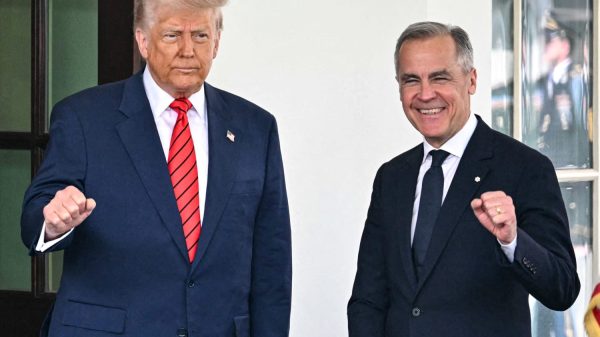
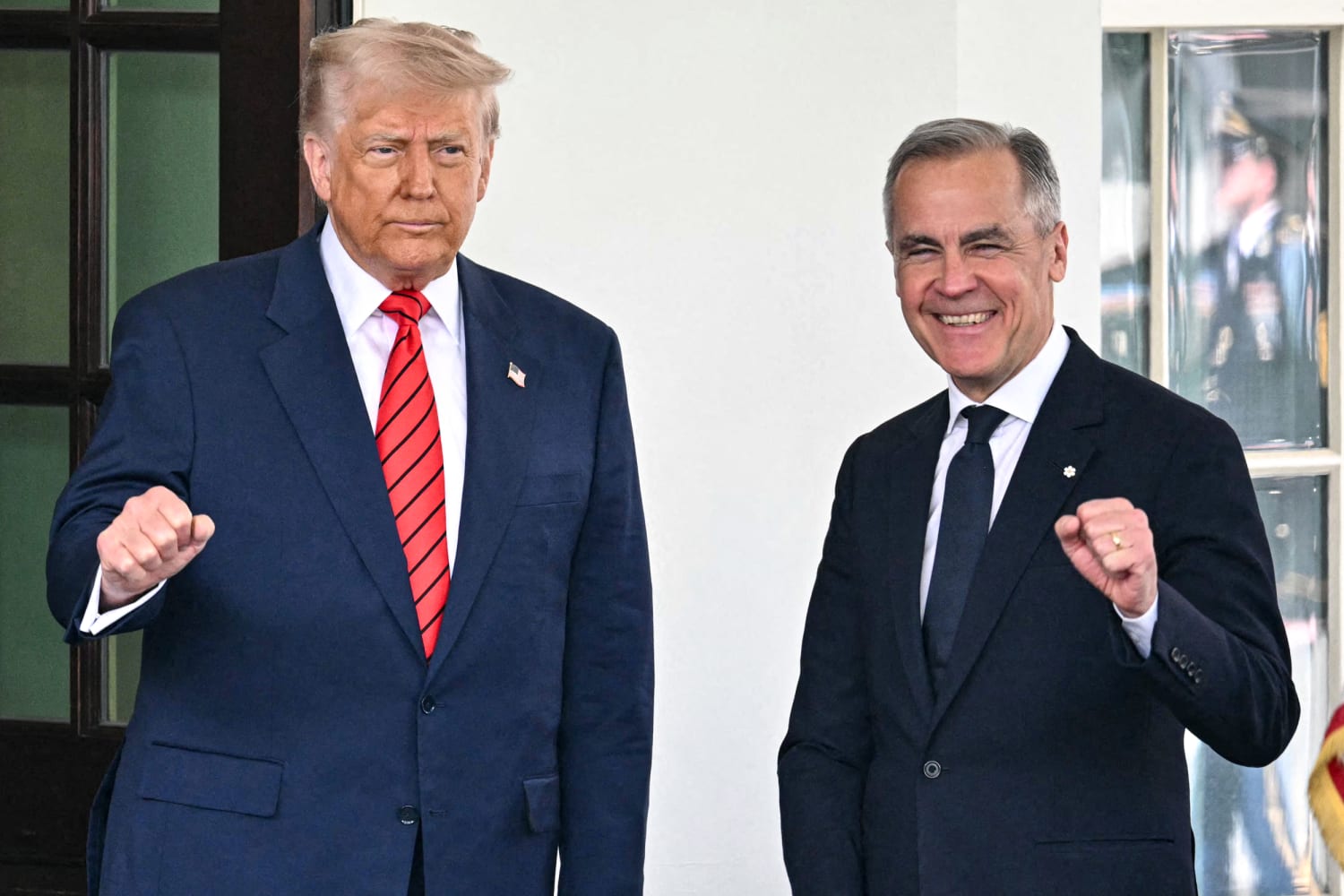
From the outset Prime Minister Mark Carney invested considerable effort in improving relations with President Trump. The two leaders met in the White House on 6th May. The meeting, reportedly, went well.
Asked at the press briefing after the meeting about Trump’s suggestions that Canada should become the 51st US state, Carney responded humorously. He recalled that during the recent elections he had met the owners of Canada. They were not he said interested in ‘selling the property’, something that Mr Trump as a property man would understand. Smiling President Trump responded ‘never say never.’
At the G7 meeting held in Kananaskis, Alberta, in June President Trump and Mr Carney had another cordial meeting.
The cordiality did not last long. At the end of June the first payments on Canada’s Digital Services Tax (DST) were due to be made. The DST legislation enacted during the Trudeau Government, hit US tech companies causing fury in the White House. Trump called the tax a “direct and blatant attack on our country” and announced all trade talks with Canada would cease immediately.
Within days Carney announced that his administration would rescind the DST and halt the collection of the tax to advance negotiations with the US.
There was another flashpoint in January when President Trump reacted to reports that Canada and China were pursuing a comprehensive free trade deal. Prime Minister Carney defused the situation by explaining the talks with China were focused on adjusting existing arrangements.
While Carney faced criticism for ‘climbing down’ on the DST issue and for being too eager to placate the White House on China, his approach got US-Canada trade talks back underway.
By August 2025 there was some optimism that a breakthrough trade talks was close. On August 18th President Trump announced that a tentative understanding had been reached and as a result he was prepared to push back on the late August deadline for US tariff increases.
The talks came to an abrupt halt three days later when Carney instructed Canada’s negotiating team to return to Ottawa.
That decision came as a surprise. Walking away risked incurring the wrath of President Trump. That was a risk that the Canadian PM had clearly calibrated.
When the US Trade Representative Jamieson Greer sought to blame Canada for the breakdown Carney responded that it was the US United States that made last-minute demands which Canada considered unacceptable, including efforts to introduce provisions that would impact Canada’s trade autonomy and sovereignty.
President Trump reacted immediately to Canada’s decision. Using a section of the Tariff Act 1930 that had never been used previously Trump imposed 50% tariffs across US$20 billion worth of Canadian products exported to the US.
Carney announced that Canada would hit US exports to Canada with “dollar for dollar” retaliatory measures. These would come into effect immediately after Labour Day 7th September –the day when the starting gun for US mid-term elections is ‘fired’ to get into full swing.
Asked at the press conference whether Canada was starting a trade war with the United States, Mr. Carney responded: “you’re at war when you get attacked—we got attacked.”
In a televised address, Carney acknowledged that the steps he was taking would come at a cost but argued that U.S. actions had left him with little alternative. He characterized the measures being taken by the United States as an attempt to hurt and divide Canadians. That, he suggested, was a miscalculation. Rather than weakening Canada, U.S. pressure would, he said, bring Canadians closer together.
Backing Carney
All of indications suggest that Prime Minister Carney was correct in his assessment.
The leader of the Conservative Party Canada, Pierre Poilievre who previously accused Carney of being too willing to concede to Trump, strongly supported the decision to walk away from those trade talks.
Mr Poilievre was not alone, with one exception the Premiers of Canadian Provinces publicly supported Prime Minister Carney’s stance.
The Premier of Ontario Canada’s most populous province, Doug Ford, an open critic of the US President, encouraged PM Carney to respond to Trump “tariff for tariff, dollar for dollar.”
The Quebec Premier, Christine Fréchette, was particularly supportive of Carney’s refusal to make concessions to Trump on Quebec’s cultural protections.
Other Premiers have encouraged Carney to “fight back,” praised “team Canada,” criticised US tariff threats as unjustified, promised “full support,” and urged that Canada not accept a ‘subordinate economic relationship’ to the US.
The Premier of Alberta where a referendum on a range of questions including Alberta’s future within Canada is to be held on 19th October was the lone outrider, cautioning against celebrating retaliatory tariffs and expressed the hope that negotiations be resumed.
Public support in Canada for the position taken by Carney has been positive. Reuters referred to the tariff dispute encouraging a ‘rally around Canada’ effect that will likely dampen support for Alberta separation from Canada.
Ten days after the Canadian negotiating team abandoned the trade talks in Washington Carney’s Liberal Party received a very tangible indication of voter support when it won three by-elections for seats in the Canadian House of Commons including a seat in Quebec that had previously been held by a Conservative Party Member.
Opinion polls since the Canadian team walked away from the negotiations also show strong support for the position taken the Carney government.
An Ipsos poll taken on August 26-27 indicates support across party lines for Canada standing up to the US – even if it resulted in higher costs and job losses: 63% of those surveyed felt Canada was right to stand firm in the negotiations. Just 18 per cent said Canada should have made additional sacrifices to get a deal.
An Angus Reid Institute poll taken on 22 and 23 August immediately after the talks were ended found that 76% supported the line taken by the Canadian government.
A third poll by Abacus Data one of Canada’s most cited polling firms found that 60% approved of how the Carney government had handled the dispute while 18% disapproved.
Negatives for Trump
In the US, unsurprisingly, positions on the trade war with Canada splits along party lines. Democrats overwhelmingly oppose the Trump’s position arguing that tariffs cost consumers and businesses.
On 9th September a group of nine Democrat Senators from states with close business ties with Canada issued a joint statement attacking President Trump’s “senseless trade war” with a key trading partner, primary export market and most enduring defence partner, pointing out that the President’s actions would force Canada to “diversify away from the US and deepen trade ties with other countries including China.”
Republicans generally, but not universally, support Trump’s position, arguing that Trump’s tariff stance is ‘putting America first.’ Concerns have been flagged in the Republican ranks that the tariffs will be an issue in the November mid-terms, particularly in competitive Senate and House races.
Senator Susan Collins of Maine, the US state most exposed to the tariff dispute with Canada, who is facing a tough re-election contest in November has labelled the tariffs on Canada ‘a mistake’ pointing out that Canadian retaliation could cost Maine up to $170 million in export losses. The Republican governor of Vermont has also been openly critical.
The position for President Trump is considerably less positive than that of Prime Minister Carney. The Canadian Prime Minister enjoys the public and political support that President Trump conspicuously lacks. As this week’s appearance in the European Parliament demonstrated Mr Carney’s support is not confined to Canada; he has international support which, President Trump again conspicuously lacks.
At the moment there is no obvious ‘off ramp’ to facilitate a return to the negotiating table. Politically and temperamentally it will be harder for President Trump to pull back from the position he has taken in the tariff war than it will be for Mark Carney. Mr Carney has more political support for his position, at home and internationally than President Trump. He has also played an infinitely better game than Mr Trump. For the moment the ball is very much in Mark Carney’s court.
Dick Roche is a former Irish Minister for European Affairs and former Minister for the Environment.